
The problem with as-builts
Every existing facility is supposed to have current as-built drawings. Almost none do. They're out of date by year five, missing renovations entirely by year ten, and useful primarily as kindling by year twenty.
The retrofit engineer who designs from those as-builts is designing to a building that doesn't exist. Field conditions don't match. Pipes are where they shouldn't be. Equipment connections are different. The contractor finds out, files RFIs, and the change orders start.
What 3D Revit changes
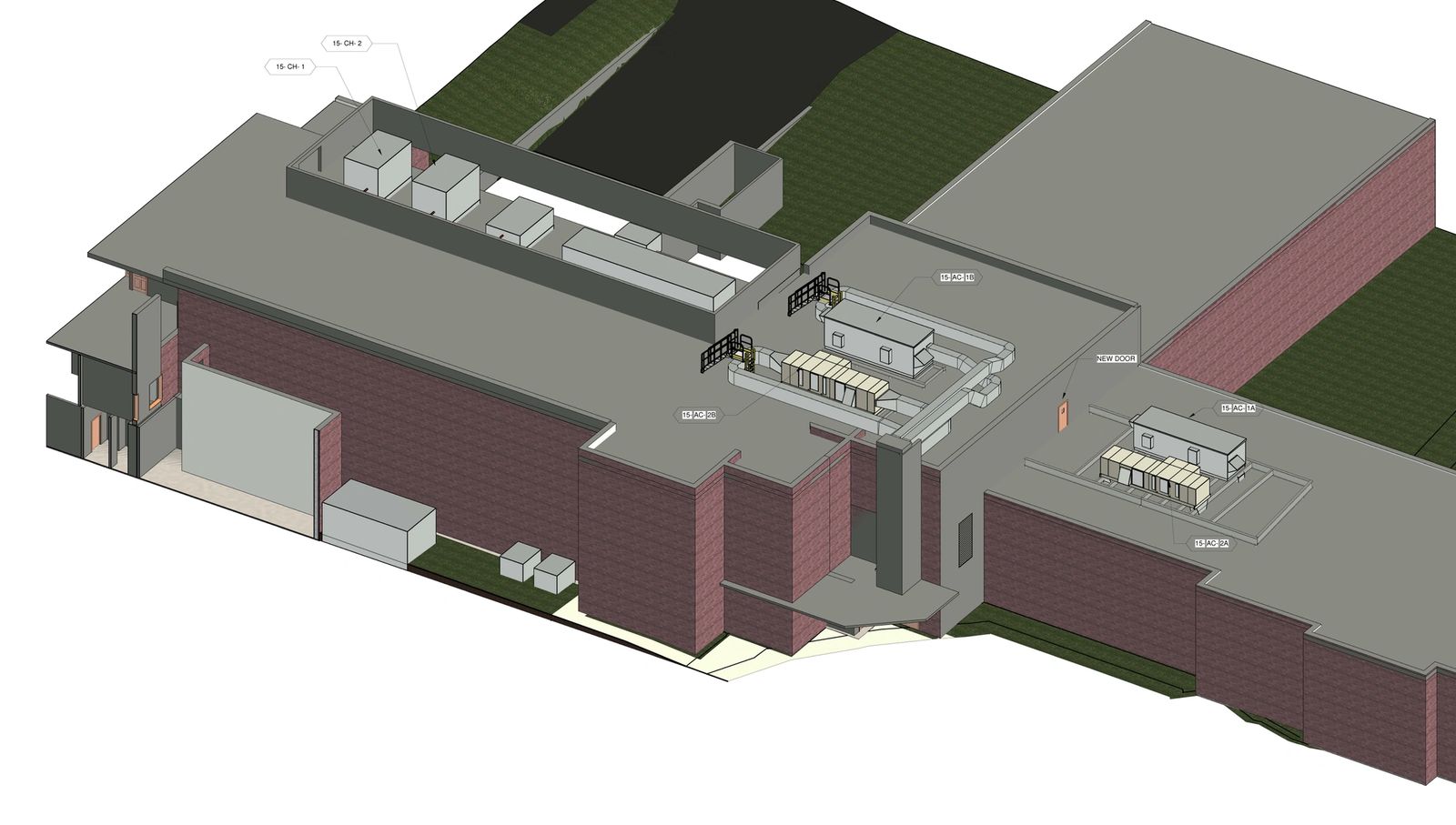
We start every MEP retrofit by surveying the actual building. For accessible spaces, that's a measured drawing. For tight or hazardous spaces, it's laser scanning — sub-centimeter accurate point clouds that become the basis of a Revit BIM model.
The result: a digital twin of what's actually there, not what the original drawings claimed. The retrofit design is laid into that model. Conflicts get resolved on screen, before they're priced.
The Manchester VAMC story
One of our hardest recent retrofits was at the Manchester VA Medical Center — replacing 500 feet of steam piping in a subbasement tunnel under active patient care areas. Parts of the tunnel were four feet high. Walking it for a survey was unsafe and impractical.
We sent in a remote-access vehicle with a three-camera system. It captured every steam trap, valve and component along the run. The video became the basis of the Revit model. The contractor got a bid package that included actual footage of the tunnel they were bidding on.
The bids came in tighter and more realistic. Construction proceeded with almost no change orders related to existing conditions.
Why this matters for owners
Change orders on healthcare and federal retrofits are not a 3% line item. They're the difference between an on-budget project and a crisis. Most of them trace back to the same root cause: the design didn't know what was there.
Better surveying upstream is the cheapest insurance policy in construction.
The cost vs. benefit math
Laser scanning and Revit modeling adds a small percentage to design fees — usually less than 2% of project cost. The change orders it prevents typically run 5–15% of project cost on retrofits in occupied facilities.
The math isn't close.
Bottom line
If your retrofit engineer is still working from old as-builts, you're paying for surprises later. The fix is upstream, and it's cheap.